-
-
46
- 작성자박은영
- 작성일2023-01-16
- 628
- 동영상동영상
-
-
44
- 작성자박은영
- 작성일2023-01-16
- 715
- 동영상동영상
-
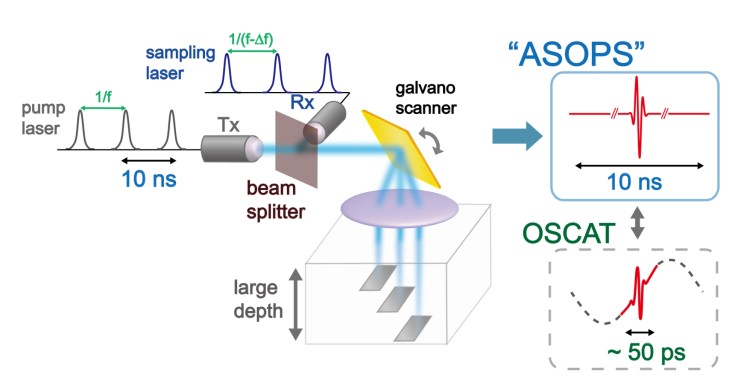
Terahertz Nondestructive Time-of-flight Imaging with a Large Depth Rangeby Hwan Sik Kim; Jangsun Kim; Yeong Hwan AhnCurrent Optics and Photonics 2022, 6(6), 619-626; https://doi.org/10.3807/COPP.2022.6.6.619 AbstractIn this study, we develop a three-dimensional (3D) terahertz time-of-flight (THz-TOF) imaging technique with a large depth range, based on asynchronous optical sampling (ASOPS) methods. THz-TOF imaging with the ASOPS technique enables rapid scanning with a time-delay span of 10 ns. This means that a depth range of 1.5 m is possible in principle, whereas in practice it is limited by the focus depth determined by the optical geometry, such as the focal length of the scan lens. We characterize the spatial resolution of objects at different vertical positions with a focal length of 5 cm. The lateral resolution varies from 0.8-1.8 mm within the vertical range of 50 mm. We obtain THz-TOF images for samples with multiple reflection layers; the horizontal and vertical locations of the objects are successfully determined from the 2D cross-sectional images, or from reconstructed 3D images. For instance, we can identify metallic objects embedded in insulating enclosures having a vertical depth range greater than 30 mm. For feasible practical use, we employ the proposed technique to locate a metallic object within a thick chocolate bar, which is not accessible via conventional transmission geometry. Keywords: Terahertz spectroscopy and imaging; Three-dimensional imaging
-
42
- 작성자박은영
- 작성일2023-01-16
- 589
- 동영상동영상
-
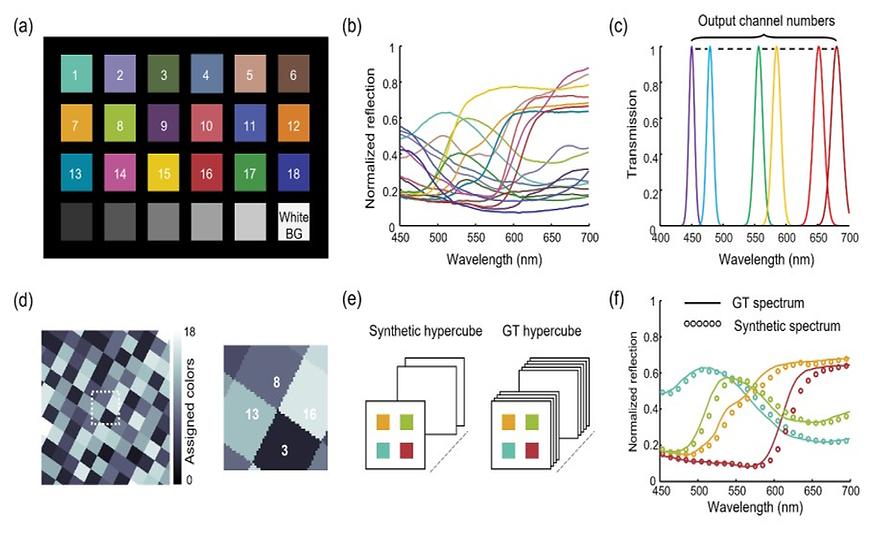
Study of a deep learning-based method for improving the spectral resolution of the spectral scanning hyperspectral imaging system via synthetic spectral image databy Suhyun Kim; Sera Jung; Jonghee YoonJournal of Physics D: Applied Physics 2023, 56; https://doi.org/10.1088/1361-6463/acae31 AbstractHyperspectral imaging (HSI) techniques, measuring spatial and spectral information, have shown the ability to identify targets based on their spectral features. Among many HSI methods, a spectral scanning HSI method implemented using a tunable filter has been widely used in various applications due to wide-area HSI capability and cost-effectiveness. However, the limitation of the spectral scanning method is poor spectral resolution compared to other spectral imaging methods using dispersive materials. To overcome this limitation, we exploited a recently developed deep-learning model that retrieves multispectral information from an red, green, and blue image. Moreover, this study proposed that a color chart consisting of 18 colors could be a standard target for training the deep-learning model under various spectral scanning HSI conditions. The simulation work was performed to demonstrate the feasibility of the proposed method using synthetic hyperspectral images. Realistic synthetic data was prepared using spectral data obtained via a spectrometer (ground-truth data) and artificial filters emulating a liquid-crystal tunable filter. We found that the deep-learning model trained via a supervised learning approach using synthetic hyperspectral images successfully retrieved high-resolution spectral data. In addition, the trained deep-learning model retrieved robust spectral profiles of random colors which were not used in the training process. Collectively, the deep learning-based spectral scanning method could improve the spectral resolution of the imaging system, and the color chart would be a good and practical standard training target for the deep learning model.
-
40
- 작성자박은영
- 작성일2023-01-16
- 649
- 동영상동영상
-
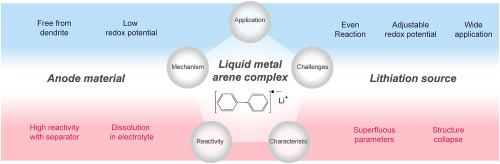
Liquid metal arene complex for next-generation batteriesby Ji-Su Woo;Hyun-Wook Lee;Ji-Hee Lee;Seung-Hun Han;Won-Jin KwakMaterials Today Energy 2023, 30, 101156; https://doi.org/10.1016/j.mtener.2022.101156 AbstractLithium metal batteries have received attention as next-generation systems owing to their high energy density compared to that of commercial lithium-ion batteries. However, low stability and cycle life with dendrite growth hinder the practical application of metal anodes. To conquer these limitations, studies utilizing dendrite-free liquid-phase anodes, such as liquid metal and liquid metal arene complexes (LMACs), have been conducted. LMAC is more controllable and stable than liquid metal; therefore, the use of LMAC has been recently investigated in various systems. Herein, a detailed overview of LMAC including the principle and characteristics has been provided. Additionally, based on recent research utilizing LMAC as an anode or a lithiation source, obstacles limiting the practical application of LMAC along with future research directions are discussed. Keywords: Next-generation batteriesLiquid electrodesLiquid metal arene complexesLithiationRecycling
-
38
- 작성자박은영
- 작성일2023-01-16
- 660
- 동영상동영상
-
Delocalization and re-entrant localization of flat-band states in non-Hermitian disordered lattice models with flat bands by Sangbum Kim;Kihong Kim Progress of Theoretical and Experimental Physics 2023 2023(1); https://doi.org/10.1093/ptep/ptac162 Abstract We present a numerical study of Anderson localization in disordered non-Hermitian lattice models with flat bands. Specifically, we consider 1D stub and 2D kagome lattices that have a random scalar potential and a uniform imaginary vector potential and calculate the spectra of the complex energy, the participation ratio, and the winding number as a function of the strength of the imaginary vector potential, h. The flat-band states are found to show a double transition from localized to delocalized and back to localized states with h, in contrast to the dispersive-band states going through a single delocalization transition. When h is sufficiently small, all flat-band states are localized. As h increases above a certain critical value h1, some pairs of flat-band states become delocalized. The participation ratio associated with them increases substantially and their winding numbers become nonzero. As h increases further, more and more flat-band states get delocalized until the fraction of the delocalized states reaches a maximum. For larger h values, a re-entrant localization takes place and, at another critical value h2, all flat-band states return to compact localized states with very small participation ratios and zero winding numbers. This re-entrant localization transition, which is due to the interplay among disorder, non-hermiticity, and the flat band, is a phenomenon occurring in many models having an imaginary vector potential and a flat band simultaneously. We explore the spatial characteristics of the flat-band states by calculating the local density distribution.
-
36
- 작성자박은영
- 작성일2023-01-16
- 622
- 동영상동영상
-
Giant overreflection of magnetohydrodynamic waves from inhomogeneous plasmas with nonuniform shear flows by Seulong Kim;Kihong Kim Physics of Fluids 2022, 34(12); https://doi.org/10.1063/5.0127265 Abstract We theoretically study mode conversion and resonant overreflection of magnetohydrodynamic waves in an inhomogeneous plane-stratified plasma in the presence of a nonuniform shear flow using precise numerical calculations of the reflection and transmission coefficients and the field distributions based on the invariant imbedding method. Cases where the flow velocity and the external magnetic field are directed perpendicularly to the inhomogeneity direction and both the flow velocity and the plasma density vary arbitrarily along it are considered. When there is a shear flow, the wave frequency is modulated locally by the Doppler shift, and resonant amplification and overreflection occur where the modulated frequency is negative and its absolute value matches the local Alfvén or slow frequency. For many different types of the density and flow velocity profiles, we find that, especially when the parameters are such that the incident waves are totally reflected, there arises a giant overreflection where the reflectance is much larger than 10 in a fairly broad range of the incident angles, the frequency, and the plasma β, and its maximum attains values larger than 105. In a finite β plasma, both incident fast and slow magnetosonic waves are found to cause strong overreflection and there appear multiple positions exhibiting both Alfvén and slow resonances inside the plasma. We explain the mechanism of overreflection in terms of the formation of inhomogeneous and open cavities close to the resonances and the strong enhancement of the wave energy due to the occurrence of semi-bound states there. We discuss the observational consequences in magnetized terrestrial and solar plasmas.
-
34
- 작성자박은영
- 작성일2023-01-16
- 645
- 동영상동영상
-
Two-Photon Fluorescent Probes for Quantitative Bio-Imaging Analysis in Live Tissues by Vinayak Juvekar;Hyo Won Lee;Dong Joon Lee;Hwan Myung Kim TRAC-TRENDS IN ANALYTICAL CHEMISTRY 2022, 157(0); https://doi.org/10.1016/j.trac.2022.116787 Abstract Two-photon (TP) microscopy (TPM) is an indispensable visualization tool for deep-tissue imaging. TPM uses the low energy light of the near-infrared window as an excitation source of fluorophores which reduces autofluorescence, photodamage, and light scattering, resulting in high resolution fluorescence images potentially beyond several millimeter depths in living systems. Due to the continuous development of the microscope and advances in optical output algorithms, it is crucial to develop innovative strategies for the quantitative analysis of biomedically relevant target analytes in living systems using TP fluorescence probes. In this review, we have highlighted ratiometric TP probe design strategies with representative ratiometric TP sensors in the last decade. We have also summarized the recent progress in the development of TP probes published between 2017 and 2022 for quantitatively detecting analytes such as enzymes, reactive species, bio-thiols, pH, neutral molecules, and metal ions in live cells and tissues. Keywords: Bio-imagingQuantitative analysisTwo-photon probesTissue imagingTwo-photon microscopy
-
32
- 작성자박은영
- 작성일2023-01-16
- 630
- 동영상동영상
-
-
30
- 작성자박은영
- 작성일2023-01-16
- 642
- 동영상동영상
-
Cytoplasmic molecular chaperones in Pseudomonas species. by Hyunhee Kim;Seongjoon Moon;Soojeong Ham;Kihyun Lee;Ute Römling;Changhan Lee Journal of Microbiology 2022, 60(0); https://doi.org/10.1007/s12275-022-2425-0 Abstract Pseudomonas is widespread in various environmental and host niches. To promote rejuvenation, cellular protein homeostasis must be finely tuned in response to diverse stresses, such as extremely high and low temperatures, oxidative stress, and desiccation, which can result in protein homeostasis imbalance. Molecular chaperones function as key components that aid protein folding and prevent protein denaturation. Pseudomonas, an ecologically important bacterial genus, includes human and plant pathogens as well as growth-promoting symbionts and species useful for bioremediation. In this review, we focus on protein quality control systems, particularly molecular chaperones, in ecologically diverse species of Pseudomonas, including the opportunistic human pathogen Pseudomonas aeruginosa, the plant pathogen Pseudomonas syringae, the soil species Pseudomonas putida, and the psychrophilic Pseudomonas antarctica.
-
28
- 작성자박은영
- 작성일2023-01-16
- 626
- 동영상동영상

 [논문] 김상범, 김기홍 - Delocalization and re-entrant localization of flat-band states in non-Hermitian disordered lattice model 위치 확인